
DSCR Loans: Why One Application to Many Lenders Saves Deals
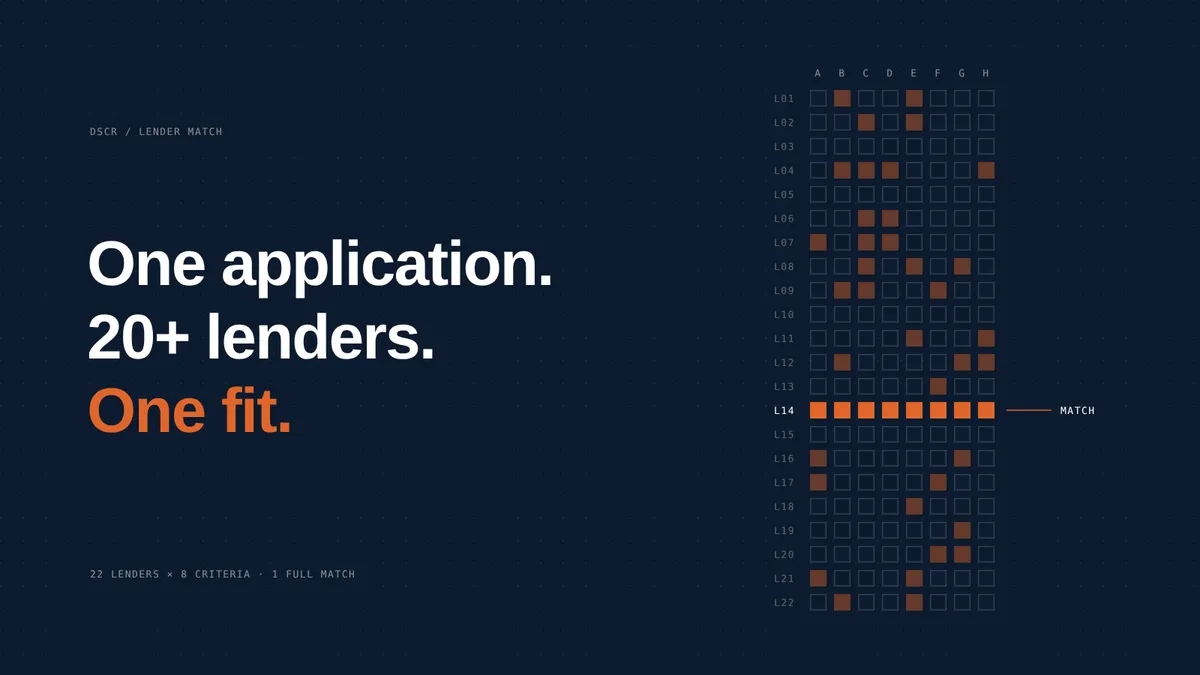
DSCR loans let real estate investors qualify on a property's rental income instead of their tax returns. Here's the part most investors don't hear until a deal is already in trouble: every DSCR lender writes its own rules. A file one lender turns down can be a clean approval somewhere else. That's why we shop one application across many lenders, and it's why this guide is built around the question that actually decides your deal: whose guidelines fit it?
What is a DSCR loan?
A DSCR loan is an investment property mortgage that qualifies you on the property's rental income instead of your personal income. The lender compares the rent to the monthly payment, so you don't hand over tax returns or W-2s to qualify.
DSCR stands for debt service coverage ratio. These loans can skip personal income because federal rules treat credit used to buy or improve a rental you don't live in as business-purpose credit under Regulation Z, outside the Truth in Lending rules written for consumer home loans. That's what makes them such a fit for self-employed investors and anyone whose write-offs make their income look smaller on paper than it really is.
How is the DSCR ratio calculated?
Divide the property's gross monthly rent by its total monthly housing payment: principal, interest, taxes, insurance and HOA dues. A result of 1.0 means the rent exactly covers the payment, and anything above 1.0 means the property has room to spare.
Quick example with round numbers: rent of $3,000 against a $2,500 total payment gives you a DSCR of 1.20. Want to test your own deal? Run it through our DSCR calculator before you make an offer.
Why does one DSCR lender decline a deal another will approve?
Because there's no single DSCR rulebook: each lender sets its own minimum ratio, credit floor, eligible property types and list of costs that count in the payment. Change the lender and the same property can go from "doesn't work" to "clear to close."
One lender may want a ratio of 1.0 or higher, while another will look at a lower ratio if you bring more money down, and some no-ratio programs don't set a minimum at all. Lenders also differ on:
Which fees go into the monthly payment, such as HOA dues or mandatory community and club fees
Which properties they'll finance, from condos to short-term rentals
Whether interest-only payments are available
How the prepayment penalty is structured
This flexibility is also why investors outgrow conventional financing. Fannie Mae's guidelines cap investment and second home borrowers at 10 financed properties through its automated underwriting. The DSCR lenders we work with set their own limits instead.
What happens when a DSCR lender can't close your deal?
You don't have to lose the property: a lender whose guidelines fit the problem can often still close it. On a deal in Reunion, Florida, we found that lender among more than 20 partners and went from submission to clear to close in 8 days.
Here's how it happened.
They were already under contract when their lender said it couldn't close. The property was in Spectrum at Reunion, a resort community in Reunion, Florida, where owners pay mandatory membership fees for the golf course and other amenities. Once those fees went into the monthly payment, the payment was too high and the numbers no longer worked for that lender's DSCR.
I sent the scenario to more than 20 lenders I partner with and described exactly what we were up against. One of them allowed for those membership fees. To get the ratio where it needed to be, we bought down the rate and switched to a 30-year loan with interest-only payments for the first 10 years.
From submission to clear to close took 8 days.
A single-lender shop has one set of guidelines to check. We had more than 20 to ask.
Should you use a DSCR lender or a mortgage broker?
A direct lender can only offer its own DSCR programs, while a broker can match your file to many lenders' guidelines from one application. If your deal is plain vanilla, either can work; if it has a wrinkle, having more than one set of guidelines to check is what keeps it alive.
The CFPB puts it simply: a lender makes loans directly, while a broker helps you find different lenders and is paid a loan-specific fee for that service. Most borrowers never compare: in a 2015 report, the CFPB found that fewer than one in four borrowers apply with more than one lender or broker.
Direct DSCR lender | Mortgage broker | |
|---|---|---|
Programs you can access | That lender's own guidelines | Many lenders' guidelines |
If the file doesn't fit | Start over with a new lender | Re-route the same file |
Applications you fill out | One per lender you try | One |
Best fit for | A simple deal that matches their box | Deals with a wrinkle, or investors who want options compared |
What are DSCR loan requirements?
DSCR lenders look at four things: the property's ratio, your credit score, your down payment and your cash reserves. Through the lenders we work with, credit scores start at 620 and down payments start at 15%, as of October 2026 and subject to change.
Those are starting points, not a promise. Reserves typically run 3 to 12 months of payments, depending on the lender and the deal. Your exact terms depend on the property, your ratio, your credit and the lender whose guidelines fit your file.
What if the rent doesn't cover the payment at all? We also have no-ratio DSCR options, where the property doesn't have to hit a minimum ratio to qualify. Ask us whether your deal fits one.
How much down payment do you need for a DSCR loan?
Through our lender network, DSCR down payments start at 15%, as of October 2026 and subject to change. A bigger down payment lowers the loan amount, which lowers the payment and lifts your ratio.
The minimum isn't always the right move. On a borderline ratio, putting more down can be what makes the numbers work, so it's worth running a few scenarios before you're under contract, not after.
What properties qualify for a DSCR loan?
DSCR loans are for investment properties, such as 1–4 unit rentals, condos and short-term rentals, depending on the program. Your own home doesn't qualify.
This is another place lenders split. A property one lender won't touch, like a home in a community with unusual mandatory fees, may be routine for another.
What moves DSCR loan rates?
Your ratio, credit score, down payment and prepayment structure drive most of the pricing. Paying points to buy down the rate, or choosing interest-only payments, can also change the payment enough to make a borderline ratio work.
In our experience, interest-only lowers the payment but can change the pricing, so the right structure depends on how long you plan to hold. We don't post a rate on this page because DSCR pricing depends on your file and changes with the market; a quote is free and takes minutes.
Do DSCR loans have prepayment penalties?
Through the lenders we work with, many do, and the penalty usually steps down each year over a set period. A longer penalty can earn a lower rate, while a short or zero penalty usually costs more upfront.
Match the penalty to your plan. If you're holding for the long term, a longer penalty can save you money; if you might sell or refinance soon, paying for a shorter one can be the cheaper move.
Can you get a DSCR loan in an LLC?
Yes, through our lender network many DSCR programs let you close in an LLC. You'll usually sign a personal guarantee, and the lender will still review your credit.
Closing in an entity is one of the reasons investors use DSCR loans to scale. Confirm with your attorney or CPA how you want the LLC set up before you apply, because the lender will ask for the entity documents.
What are the pros and cons of DSCR loans?
The pros are qualifying without income documents, closing in an LLC and growing past conventional limits. The cons are larger down payments than owner-occupied loans, reserve requirements and prepayment penalties, so the deal has to cash flow on its own.
Pros
Qualify on the property's rent, not your tax return
Close in an LLC
Scale beyond conventional financed-property limits
Interest-only and other structures on many programs
Cons
Down payments start at 15% through our lenders (as of October 2026)
Reserves of 3 to 12 months are typical
Prepayment penalties are common
Guidelines vary, so the wrong lender can stall a good deal
How do you get a DSCR loan, and how long does it take?
Start with the property numbers, then submit one application and let it go to the lenders whose guidelines fit your deal. Timelines depend on the lender and the property; the client above went from submission to clear to close in 8 days.
Here's how it works with us:
Run the numbers. Use the DSCR calculator to check your ratio.
Apply once. See what you qualify for in about 60 seconds or less. No obligation, no hard credit pull to start.
Talk to Trevor. I call you personally the same day.
We shop your file. Your scenario goes to the lenders whose guidelines fit it, with approvals possible in as little as 24 hours, subject to credit approval and underwriting.
Close. We stay on the file through clear to close.
Ready to finance your next property? Get a custom quote in minutes. No obligation, no hard credit pull to start.
Get Started Now or book a free consultation. Want the full program overview first? See our DSCR loans page.
This article is for general education and is not a commitment to lend. DSCR program guidelines, ratios, credit minimums, down payments, reserves and terms vary by lender and are subject to change; program figures reflect our lender network as of October 2026. All loans are subject to credit approval and underwriting. ReBroker Buddy (Broker Buddy LLC), powered by Adaptive Mortgage Solutions, 5371 Wilshire Dr., San Diego, CA 92116, (619) 404-6637. Company NMLS #2022974, CA DRE #02126109. Equal Housing Opportunity.


