Looking for a DSCR Loan in Georgia?
We are the experts!
Qualify Based on Rental Income Only!
No Personal Income Needed to Qualify!
Interest Only Options Available!
Fund Into Corporation or LLC
No Pre-Pay Options
AirBnB's Allowed
Answer a Few Quick Questions and Let’s See if You’re Eligible
🔒 This site is secure
🔒 This site is secure
Qualify Based on bank statements only!
No W2's or Tax Returns Needed!
Interest Only Options Available!
Get up to 90% Financing
100% Gift Funds Allowed
Fixed Rate and Adjustable Rate Options
DSCR Loans in Georgia: Finance Rentals on the Property's Income
A DSCR (debt service coverage ratio) loan lets Georgia investors qualify using the rent a property earns instead of personal tax returns, W-2s, or pay stubs. If the rent covers the mortgage payment, taxes, insurance, and any HOA dues, the property can usually carry its own loan. Georgia's rental demand is centered on metro Atlanta, with additional markets in Savannah, Augusta, Columbus, Macon, Athens and military towns such as Hinesville and Warner Robins. Rental homes are assessed at the same 40% of fair market value as other property, but owner-occupant homestead exemptions and assessment protections do not apply to them.
Broker Buddy shops DSCR programs from multiple wholesale lenders for single-family homes, 2–4 unit properties, condos and townhomes across all 159 Georgia counties — purchases, rate-and-term refinances, and cash-out refinances.
Georgia DSCR Loan Guidelines at a Glance
DSCR programs each have their own rulebook, but most Georgia rental loans sit inside the ranges below. We compare several lenders on every file, so if one program's guideline doesn't fit, another often will.
| Guideline | Typical range in Georgia |
|---|---|
| Credit score | Programs often start around 620–660; 700+ gets the most leverage and the strongest pricing |
| Down payment / LTV | Generally 20–25% down (up to 80% LTV) for purchases and rate-and-term refinances; cash-out usually tops out near 75% LTV, and lower scores may be held to 65–70% |
| Minimum DSCR | 1.00 is the typical target; some programs accept 0.75–0.99, and no-ratio options exist for properties still being leased up |
| Reserves | Usually 3–6 months of PITIA after closing; larger loans and lower scores can require more |
| Loan size | Minimums commonly start around $75,000–$100,000 — worth knowing in lower-priced Macon, Columbus and Augusta neighborhoods — with jumbo DSCR programs into the millions |
| Property types | Single-family, 2–4 units, condos and townhomes, plus eligible short-term rentals; select programs cover 5–10 units and mixed-use |
| Who can borrow | Georgia DSCR loans close in an LLC or other entity, with the owners signing a personal guarantee; set up the entity before you go under contract |
| Closing costs | Georgia charges an intangible recording tax on the new mortgage of $1.50 per $500 of the loan amount (about 0.3%), capped at $25,000 |
| Time to close | Roughly 3–5 weeks after the appraisal is ordered |
Guidelines change often and depend on lender, credit and property. Try our DSCR calculator to check a deal, or see how 30-year, 40-year, interest-only and ARM terms change the payment and the ratio.
Why Investors Are Buying Rentals in Georgia
- Delta Air Lines is headquartered at Hartsfield-Jackson Atlanta International Airport and employs more than 36,800 Georgians, according to the state's economic development department.
- Georgia's ports supported nearly 651,000 jobs statewide in fiscal 2024 (about 12% of state employment), and the Port of Savannah moved 5.7 million TEUs in fiscal 2025.
- Military installations anchor local rental demand, including Fort Stewart and Hunter Army Airfield (Hinesville and Savannah, over 25,500 people employed) and Robins Air Force Base near Warner Robins (a workforce of 22,387 in fiscal 2024).
- The University System of Georgia enrolled a record 382,142 students across 26 institutions in fall 2025, with Georgia Tech in Atlanta the largest at 56,715 students.
- Tourism drew 174.2 million visitors and supported 470,570 jobs in Georgia in 2024, supporting short-term and workforce rental demand from the North Georgia mountains to Savannah and the coast.
Georgia Rental Markets Worth a Closer Look
Georgia's rental demand reaches well beyond Atlanta. Here's how investors tend to think about the state's main markets — run the numbers on any specific address before you offer.
Gwinnett, Henry, Clayton, Douglas and Paulding counties offer newer single-family homes at lower prices than intown Atlanta, with strong demand from families who work at the airport, logistics hubs and corporate offices.
Beyond the historic district, Pooler, Richmond Hill and Rincon are growing fast thanks to the port, Gulfstream and the Hyundai Metaplant in Bryan County. Coastal homes need a close look at flood and wind coverage.
Fort Gordon, home of Army cyber operations, plus the Augusta University medical complex and the Savannah River Site keep rental demand steady in Augusta, Grovetown and Evans.
Fort Benning's training mission brings a constant flow of military families, and Columbus offers some of the lowest entry prices of any Georgia metro.
Warner Robins and Macon draw on Robins Air Force Base, healthcare and manufacturing employers, with affordable 3-bedroom homes that often pencil out at 1.00 or better.
Athens rentals serve University of Georgia students and staff, while Hinesville sits just outside Fort Stewart, where military households keep vacancy low.
Want a quick read on what a Georgia property should rent for before you write an offer? Try our free DSCR rent estimate tool.
Georgia Rent Benchmarks
Lenders qualify DSCR loans using the lower of the current lease or an appraiser's market-rent estimate, so it helps to know where local rents sit before you make an offer. HUD's Fair Market Rents are a useful, neutral starting point:
| Area | 2-bedroom | 3-bedroom | 4-bedroom |
|---|---|---|---|
| Savannah MSA | $1,679 | $2,185 | $2,484 |
| Atlanta-Sandy Springs-Roswell HMFA | $1,762 | $2,099 | $2,493 |
| Gainesville MSA | $1,543 | $1,860 | $2,222 |
| Warner Robins HMFA | $1,396 | $1,860 | $2,238 |
| Hinesville HMFA | $1,396 | $1,815 | $2,333 |
| Augusta-Richmond County HMFA | $1,329 | $1,672 | $2,035 |
| Brunswick-St. Simons MSA | $1,378 | $1,642 | $1,938 |
| Columbus HMFA | $1,212 | $1,611 | $1,876 |
| Athens-Clarke County MSA | $1,285 | $1,610 | $1,689 |
| Macon-Bibb County HMFA | $1,309 | $1,560 | $1,720 |
Source: HUD Fair Market Rents, FY2027 schedule (effective October 1, 2026). Fair Market Rents are a government benchmark, not an appraisal; actual market rent for a specific property may be higher or lower.
How Much Can an Atlanta Rental Support?
A quick way to size a deal is to work backward from the rent. Using the HUD 3-bedroom benchmark for the Atlanta area and some simple assumptions, here's roughly what purchase price that rent can carry with 20% down:
| Monthly rent (HUD 3-bedroom benchmark) | $2,099 |
| Purchase price the rent covers at a 1.00 DSCR | about $313,000 |
| Purchase price for a 1.20 DSCR (better pricing) | about $261,000 |
| Median value of owner-occupied homes, Atlanta | $439,600 |
Typical homes in the area cost more than a benchmark rent alone supports, so investors often put more down, choose an interest-only option, or target properties with above-benchmark rents or multiple units. Assumptions: 30-year fixed at a 7.25% example rate, with taxes and insurance estimated at 1.5% of the price per year. The median value is from U.S. Census QuickFacts. These are illustrations only — request a quote for numbers on your property.
Run your own Atlanta-area numbers, or any Georgia address, in the DSCR calculator, and see whether an interest-only or 40-year term helps a tight deal reach 1.00.
Georgia Prepayment Penalty Rules for DSCR Loans
Georgia is one of the states where lenders may include a standard prepayment penalty on investment-property (business-purpose) loans. Choosing a prepayment penalty usually lowers your rate; choosing no penalty gives you the freedom to sell or refinance at any time. We'll price both ways so you can compare.
| Prepay option | How it works | Best for |
|---|---|---|
| Flat 5% (1–5 years) | 5% of the amount prepaid during the penalty term, e.g. 5/5/5 for a 3-year term. | Long-term buy-and-hold; often the best rate |
| Step-down (5-4-3-2-1 or 3-2-1) | The penalty drops each year, e.g. 5% in year 1, 4% in year 2, down to 0% after year 5. Offered by many lenders. | A balance of rate and flexibility |
| Six months' interest | Offered by some lenders: the penalty is capped at six months of interest on 80% of the original balance. | Investors who want a smaller, predictable penalty |
| No prepayment penalty | Sell or refinance any time with no penalty, at a higher rate or price. | Flips-to-rentals, BRRRR, short holds |
Georgia-Specific Costs and Rules for Investors
Property taxes on rentals
Georgia law requires property to be assessed at 40% of fair market value, with values set as of January 1 by each county's Board of Tax Assessors and bills collected by the county Tax Commissioner. Homestead exemptions, including the $2,000 statewide standard exemption, require that the home be owned and occupied as the owner's legal residence on January 1, so they do not apply to investment rentals. The statewide floating homestead exemption created by HB 581 (2024), which limits taxable increases to an inflation index unless a local government opted out, also applies only to homesteads. Source: Georgia Department of Revenue: Property Tax Valuation.
Insurance, hurricane and flood risk
Georgia's Insurance Commissioner notes that standard homeowners policies generally exclude flood, which must be bought separately, and urges all Georgians, not only coastal residents, to consider flood coverage. NFIP flood policies usually take 30 days to take effect, so buy coverage well before hurricane season, especially for coastal rentals around Savannah and Brunswick. The office also recommends insuring a home for at least 80% of its replacement value. See Georgia Office of Insurance and Safety Fire Commissioner: Home insurance.
Short-term rentals and lodging tax
Georgia charges a $5-per-night State Hotel-Motel Fee on short-term rentals, including houses listed on online marketplaces, until a stay reaches 31 consecutive days. Marketplace innkeepers such as booking platforms must collect and remit the fee and the state sales tax on rentals they facilitate, and many cities and counties add their own local hotel-motel excise tax. Atlanta requires a short-term rental license, displayed on every listing, and limits each owner or long-term tenant to their primary residence plus one other unit. Savannah requires a Short-Term Vacation Rental certificate for whole-unit rentals of 30 days or less and allows them only in certain zoning districts. Details: Georgia Department of Revenue: State Hotel-Motel Fee FAQ.
Landlord-tenant law
Long-term rentals are governed by the Official Code of Georgia Annotated (O.C.G.A.) Title 44, Chapter 7 (Landlord and Tenant). The Georgia Landlord-Tenant Handbook (revised August 2024) says a landlord may not require a security deposit of more than two months' rent. The deposit must be returned within 30 days after the lease ends or the tenant moves out, whichever is later, along with a written list of any damage and its estimated cost if money is withheld. Read more: Georgia Department of Community Affairs: Georgia Landlord-Tenant Handbook.
Notice and timing for nonpayment evictions
Under the Safe at Home Act, for leases signed or renewed on or after July 1, 2024, a landlord must give written notice to pay or vacate that allows three business days before filing a dispossessory case for unpaid rent. The notice is posted on the door in a sealed envelope and delivered any other way the lease requires. Once served, the tenant has seven days to answer in court. Sources: Georgia Appleseed Safe at Home bench card and O.C.G.A. § 44-7-51.
No local rent control
Georgia law bars counties and cities from regulating the amount of rent charged on privately owned single-family or multi-unit rentals, so increases are set by your lease and the market. Local licensing and zoning rules still apply. Source: O.C.G.A. § 44-7-19.
State income tax on rental profits
Georgia's income tax rate dropped to 4.99% for 2026 under HB 463, and it's scheduled to keep stepping down each year. Net rental income is reported on your Georgia return; your CPA can explain how depreciation and LLC pass-through rules affect your bill. More at the Georgia Department of Revenue.
Buying in an LLC
Georgia LLCs file Articles of Organization with the Secretary of State's Corporations Division for $110 ($100 plus a $10 service charge), with a $60 annual registration due between January 1 and April 1 each year. Start here: Georgia Secretary of State: register a business. Talk to your attorney or CPA about the right structure for your situation.
Georgia County Tax Assessor Offices
Use these official county tax assessor offices to look up a property's assessed value, current tax bill and parcel details before you make an offer.
| County | Major cities | Office |
|---|---|---|
| Fulton County | Atlanta, Sandy Springs, Roswell, Johns Creek, Alpharetta | Fulton County Board of Assessors |
| Gwinnett County | Lawrenceville, Duluth, Snellville, Peachtree Corners | Gwinnett County Assessors' Office |
| Cobb County | Marietta, Smyrna, Kennesaw, Acworth | Cobb County Tax Assessor's Office |
| DeKalb County | Decatur, Dunwoody, Brookhaven, Stonecrest | DeKalb County Property Appraisal Department |
| Chatham County | Savannah, Pooler, Garden City, Tybee Island | Chatham County Board of Assessors |
| Clayton County | Jonesboro, Forest Park, Morrow, Riverdale | Clayton County Board of Tax Assessors |
| Cherokee County | Canton, Woodstock, Holly Springs | Cherokee County Tax Assessor's Office |
| Forsyth County | Cumming | Forsyth County Board of Assessors |
| Augusta-Richmond County | Augusta | Richmond County Board of Tax Assessors |
| Columbus-Muscogee County | Columbus | Muscogee County Board of Tax Assessors |
| Macon-Bibb County | Macon | Macon-Bibb County Board of Tax Assessors |
| Hall County | Gainesville, Flowery Branch, Oakwood | Hall County Board of Tax Assessors |
Other counties: The Georgia Department of Revenue's County Property Tax Facts pages cover all 159 counties, listing each county's Board of Tax Assessors and Tax Commissioner along with their websites. View the directory.
More Free Resources for Georgia Investors
- HUD Fair Market Rents — rent benchmarks by county and ZIP code
- U.S. Census QuickFacts: Georgia — population, income, and housing data
- FEMA Flood Map Service Center — look up the flood zone for any address
- Georgia Department of Revenue: State Hotel-Motel Fee FAQ — short-term rental tax rules
- Georgia Secretary of State: register a business — form or look up an entity
Georgia DSCR Loan Options & Free Tools
Georgia investors use DSCR financing for more than a basic 30-year purchase. Explore the option that fits your plan:
Check whether a Gwinnett or Henry County rental covers its payment before you make an offer.
Estimate market rent for a Savannah, Augusta or Columbus rental the way a DSCR appraiser will.
See how much cash you could pull from a Macon or Warner Robins rental with a cash-out refinance.
Compare 30-year fixed, 40-year, interest-only and ARM options and how each changes your DSCR.
Tap equity in a Georgia rental without disturbing a low-rate first mortgage.
Finance Blue Ridge cabins, Golden Isles beach homes and other licensed vacation rentals using projected nightly income.
Georgia DSCR Loan FAQs
How much do I need to put down on a Georgia DSCR loan?
Most DSCR programs require 20-25% down on a purchase. Select programs allow less with strong credit and a higher DSCR. Short-term rentals and properties with a DSCR under 1.0 usually need more down.
Do Georgia DSCR loans have prepayment penalties?
They can. Georgia permits standard prepayment penalties on investment loans, such as a flat 5% for 1-5 years or a 5-4-3-2-1 step-down, depending on the lender. You can also choose a loan with no prepayment penalty, typically at a slightly higher rate.
Can I use Airbnb income to qualify?
Yes, on eligible programs. Lenders use your booking history or a short-term rental market analysis for the property. Check local short-term rental licensing first.
Can I close in my LLC?
Yes, and in Georgia it's required: DSCR loans we arrange there must close in an LLC or other business entity, with the owners signing a personal guarantee.
Can I get a homestead exemption on a Georgia rental property?
No. Georgia homestead exemptions require that the owner occupy the home as their legal residence on January 1 of the tax year. Investment rentals are taxed on the full 40% assessed value with no homestead deduction, and they are not covered by the HB 581 floating homestead exemption that limits assessment increases on owner-occupied homes.
Can I run a DSCR-financed rental as an Airbnb in Atlanta?
Possibly, but Atlanta caps it. The city requires a short-term rental license, which must appear in every listing, and an owner or long-term tenant may license only their primary residence plus one additional unit. Platforms also collect Georgia's $5-per-night State Hotel-Motel Fee and sales tax. Check the city's current enforcement status and local hotel-motel tax before counting on short-term rental income.
What credit score do I need for a Georgia DSCR loan?
Many DSCR programs start around a 620 to 660 credit score. Scores of 700 and above usually qualify for the highest loan-to-value and the best pricing, while lower scores typically need more down.
What is Georgia's intangible recording tax on a DSCR loan?
Georgia charges $1.50 for every $500 of a long-term note secured by Georgia real estate, or about 0.3% of the loan amount, capped at $25,000 per note. It's paid at closing, usually by the borrower.
How much notice does a Georgia landlord give for unpaid rent?
For leases entered into or renewed on or after July 1, 2024, the landlord must give written notice allowing three business days to pay or vacate before filing a dispossessory case. If the tenant pays in full within that window, the landlord can't file.
Can a Georgia city cap my rent increases?
No. State law prohibits counties and cities from regulating the amount of rent on privately owned residential rentals. Local licensing, zoning and short-term rental rules still apply.
Get a Georgia DSCR Rate Quote
Tell us about the property and we'll shop multiple DSCR lenders so you can compare options. No credit check to see your options.
Check My EligibilityLooking for another state? See all DSCR loan states.
DSCR Loans Explained
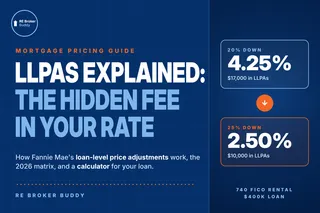
LLPA Explained: Fannie Mae's Loan-Level Price Adjustment Matrix (2026)
What a loan-level price adjustment (LLPA) is, how it works, the 2026 Fannie Mae LLPA matrix, investment property LLPAs, real-dollar examples and a calculator. ...more
DSCR loans ,Mortgage Market Updates
October 28, 2026

Rapid Rescore: How It Works, How Long It Takes and Who Pays
What a rapid rescore is, how it works, how long it takes, what it costs and who pays, what it can't fix, and a real rescore that saved $6,294 at closing. ...more
DSCR loans
October 28, 2026

FICO vs. VantageScore for Mortgages: Which Credit Score Do Lenders Use?
Which credit score mortgage lenders use, how classic FICO and VantageScore 4.0 differ, why Credit Karma doesn't match your mortgage score, and which loans now accept VantageScore 4.0. ...more
DSCR loans ,Mortgage Market Updates
October 28, 2026
Where We Offer DSCR Loans
*Must Close in LLC
STEP 1
Apply Online or Call Directly
Find out how much home you can buy or discover how much you can save by refinancing.
STEP 2
Review What Options You Can Qualify For
Learn exactly how much you qualify for and what you would save by working with us.
STEP 3
Get Loan Approval in 24 Hours
Get mortgage loan approval to move forward with your property.


Broker Buddy LLC
Trevor Gravink
Mortgage Consultant
CEO/Owner
(619) 404-6637
NMLS: 1707407
NMLS Consumer Access Lookup Tool
CA DRE # 02117228
5371 Wilshire Dr. San Diego, CA 92116
© 2026 Broker Buddy LLC
Powered by Adaptive Mortgage Solutions
Company NMLS # 2022974
CA DRE # 02126109