Looking for a DSCR Loan in Kentucky?
We are the experts!
Qualify Based on Rental Income Only!
No Personal Income Needed to Qualify!
Interest Only Options Available!
Fund Into Corporation or LLC
No Pre-Pay Options
AirBnB's Allowed
Answer a Few Quick Questions and Let’s See if You’re Eligible
🔒 This site is secure
🔒 This site is secure
Qualify Based on bank statements only!
No W2's or Tax Returns Needed!
Interest Only Options Available!
Get up to 90% Financing
100% Gift Funds Allowed
Fixed Rate and Adjustable Rate Options
DSCR Loans in Kentucky: Finance Rentals on the Property's Income
A DSCR (debt service coverage ratio) loan lets Kentucky investors qualify using the rent a property earns instead of personal tax returns, W-2s, or pay stubs. If the rent covers the mortgage payment, taxes, insurance, and any HOA dues, the property can usually carry its own loan. Kentucky combines manufacturing and logistics job centers in Louisville, Lexington and Northern Kentucky with military markets around Fort Knox and Fort Campbell. Home prices are moderate (Louisville/Jefferson County's median owner-occupied home value is $233,900), and FY2027 HUD 3-bedroom Fair Market Rents in the major metros run from about $1,440 to $1,950.
Broker Buddy shops DSCR programs from multiple wholesale lenders for single-family homes, 2–4 unit properties, condos and townhomes across all 120 Kentucky counties — purchases, rate-and-term refinances, and cash-out refinances.
Kentucky DSCR Loan Guidelines at a Glance
Every DSCR program sets its own rules, but most Kentucky rental loans fall inside these ranges. We compare several lenders at once, so if one program's guideline doesn't fit your deal, another one often will.
| Guideline | Typical range in Kentucky |
|---|---|
| Credit score | Many programs start around 620–660; 700+ unlocks the most leverage and the best pricing |
| Down payment / LTV | Usually 20–25% down (up to 80% LTV) on purchases and rate-and-term refinances; cash-out typically tops out near 75% LTV. A few programs go to 85% LTV for strong-credit borrowers. |
| Minimum DSCR | 1.00 is the common target; some programs accept 0.75–0.99, and no-ratio options exist for properties that don't cash-flow yet |
| Reserves | Often 3–6 months of PITIA after closing; larger loans and lower scores can require more |
| Loan size | Minimums commonly start around $75,000–$100,000, with jumbo DSCR programs into the millions |
| Property types | Single-family, 2–4 units, condos, townhomes and short-term rentals; select programs cover 5–10 unit buildings and mixed-use |
| Who can borrow | Individuals or an LLC; first-time investors are eligible on many programs |
| Property condition | Rent-ready with no major deferred maintenance; vacant homes are allowed on many purchases and refinances |
| Time to close | Roughly 3–5 weeks once the appraisal is ordered |
Guidelines change often and vary by lender, credit profile and property. Not sure how the ratio works? Start with our DSCR calculator or see how 30-year, 40-year, interest-only and ARM terms change your payment and ratio.
Why Investors Are Buying Rentals in Kentucky
- Kentucky's automotive sector counts more than 550 companies employing over 106,000 people, and the state says it is the top per-capita producer of cars, light trucks and SUVs, with Toyota, Ford and Chevrolet's Corvette among its manufacturers.
- Logistics is a major employer: more than 600 logistics and distribution facilities employ over 91,000 people, the state ranks first in air cargo by weight, and UPS, Amazon and DHL are among its partners.
- Two large Army installations, Fort Knox (near Radcliff and Elizabethtown) and Fort Campbell (whose housing market falls in HUD's Clarksville, TN-KY area, including Christian County), support military rental demand.
- The University of Kentucky in Lexington draws students from every state and all 120 Kentucky counties, and its UK HealthCare system (including Chandler Hospital, the region's only adult and pediatric Level 1 trauma center) is a major Lexington employer.
- Kentucky makes 95% of the world's bourbon, and its roughly 430 food and beverage operations support about 58,000 workers, while attractions such as the Kentucky Bourbon Trail and the Kentucky Derby draw visitors.
Kentucky Rental Markets Worth a Closer Look
Kentucky isn't one rental market. Here's how investors tend to think about the main areas — run the numbers on any specific address before you make an offer.
The state's largest metro, anchored by air-cargo logistics, healthcare and bourbon tourism. Neighborhoods like the Highlands, NuLu and Germantown attract renters, and a wave of new apartment deliveries has given single-family buyers more room to negotiate.
University of Kentucky students and staff, a large hospital system and horse-country tourism keep rental demand steady. Unhosted short-term rentals here need a conditional use permit, so long-term rentals are often the simpler play.
Covington, Newport, Florence and Fort Thomas sit just across the river from Cincinnati, pairing Ohio-metro jobs with Kentucky pricing. Some of these cities have adopted the URLTA even where their county has not, so check the rules address by address.
Elizabethtown and Radcliff (near Fort Knox, plus the battery-manufacturing campus in Glendale) and Hopkinsville and Oak Grove (next to Fort Campbell) see steady military and relocation demand for 3-bedroom homes.
Bowling Green (Western Kentucky University and the Corvette plant), Richmond (Eastern Kentucky University) and Murray (Murray State) offer lower entry prices and a renewing pool of tenants.
Somerset and Lake Cumberland, Paducah's river and arts district, and distillery towns like Bardstown and Lawrenceburg draw vacation renters. These are popular for short-term rental DSCR loans that qualify on projected nightly income.
Want a quick read on what a property should rent for before you write an offer? Try our free DSCR rent estimate tool.
Kentucky Rent Benchmarks
Lenders qualify DSCR loans using the lower of the current lease or an appraiser's market-rent estimate, so it helps to know where local rents sit before you make an offer. HUD's Fair Market Rents are a useful, neutral starting point:
| Area | 2-bedroom | 3-bedroom | 4-bedroom |
|---|---|---|---|
| Lexington-Fayette | $1,416 | $1,948 | $2,108 |
| Northern Kentucky (Cincinnati HMFA: Boone, Kenton, Campbell) | $1,442 | $1,897 | $2,141 |
| Christian County (Clarksville TN-KY HMFA) | $1,307 | $1,786 | $2,185 |
| Louisville (Jefferson, Bullitt, Oldham) | $1,276 | $1,629 | $1,874 |
| Owensboro | $1,138 | $1,507 | $1,516 |
| Elizabethtown (Hardin, Larue) | $1,087 | $1,505 | $1,817 |
| Franklin County (Frankfort) | $1,145 | $1,466 | $1,811 |
| Bowling Green (Warren, Edmonson) | $1,199 | $1,438 | $1,959 |
| Madison County (Richmond) | $993 | $1,375 | $1,600 |
| McCracken County (Paducah) | $1,131 | $1,348 | $1,616 |
Source: HUD Fair Market Rents, FY2027 schedule (effective October 1, 2026). Fair Market Rents are a government benchmark, not an appraisal; actual market rent for a specific property may be higher or lower.
How Much Can a Louisville Rental Support?
A quick way to size a deal is to work backward from the rent. Using the HUD 3-bedroom benchmark for the Louisville area and some simple assumptions, here's roughly what purchase price that rent can carry with 20% down:
| Monthly rent (HUD 3-bedroom benchmark) | $1,629 |
| Purchase price the rent covers at a 1.00 DSCR | about $243,000 |
| Purchase price for a 1.20 DSCR (better pricing) | about $202,000 |
| Median value of owner-occupied homes, Louisville | $233,900 |
Benchmark rents can support a typical home in the area, which is why many investors here qualify at or above a 1.00 DSCR. Assumptions: 30-year fixed at a 7.25% example rate, with taxes and insurance estimated at 1.5% of the price per year. The median value is from U.S. Census QuickFacts. These are illustrations only — request a quote for numbers on your property.
Plug in your own price, rent and terms with the DSCR calculator, or see whether an interest-only or 40-year term helps a tight deal reach 1.00.
Kentucky Prepayment Penalty Rules for DSCR Loans
Kentucky allows prepayment penalties on investment-property loans, but many lenders cap them at a 3-2-1 step-down over 3 years. Choosing a prepay usually lowers your rate; choosing no penalty gives you the freedom to sell or refinance at any time. We'll price both ways so you can compare.
| Prepay option | How it works | Best for |
|---|---|---|
| 3-year step-down (3-2-1) | 3% of the amount prepaid in year 1, 2% in year 2, 1% in year 3, then none. | Buy-and-hold investors who want the lowest rate |
| 2-year or 1-year prepay | A shorter penalty, such as 2-1 or 1% in year 1 only, depending on the lender. | Investors who may sell or refinance in a few years |
| No prepayment penalty | Sell or refinance any time with no penalty, at a higher rate or price. | Flips-to-rentals, BRRRR, short holds |
Kentucky-Specific Costs and Rules for Investors
Property taxes on rentals
Kentucky requires all non-exempt property to be assessed at its fair cash value (what a willing buyer would pay a willing seller) as of January 1 each year, by each county's elected Property Valuation Administrator (PVA), who must physically inspect every parcel at least once every four years. Rental and owner-occupied homes are valued the same way; the main difference is the homestead exemption ($49,100 off assessed value for 2025-2026), which applies only to a residence maintained and lived in by an owner who is 65 or older or totally disabled, so investment property does not qualify. Kentucky has no assessment cap, but a taxing district's rate that would raise revenue more than 4% over the prior year (excluding new property) can be petitioned to a recall vote. Source: Kentucky Department of Revenue: Residential, Farm and Commercial Property.
Insurance and flood, tornado and earthquake risk
Standard homeowners policies do not cover flood (NFIP coverage has a 30-day waiting period) or earthquake damage; Kentucky insurers must offer an earthquake endorsement, with minimum deductibles of 20% in the far-western counties such as McCracken, 15% in counties such as Daviess, and 10% elsewhere. Many policies now carry percentage-based wind and hail deductibles, and in 37 mostly coal-region counties (including Christian and Daviess) a mine subsidence endorsement is added to policies through the state's Mine Subsidence Insurance Fund. See Kentucky Department of Insurance: Consumer Publications.
Short-term rentals and lodging tax
Kentucky charges a 1% state transient room tax on rooms, cabins and other lodgings, in addition to the 6% state sales tax and any local transient room tax; continuous stays of 30 days or more are exempt. Airbnb and Vrbo collect and remit the state tax for participating hosts and, since January 1, 2023, local transient room tax as well. Louisville Metro charges an 8.5% transient room tax and requires every short-term rental (under 30 days) to register annually ($250); non-owner-occupied STRs in residential zones also need a conditional use permit and must be at least 600 feet from another CUP-approved STR. Details: Kentucky Department of Revenue: Transient Room Tax.
Landlord-tenant law
Long-term rentals are governed by the Uniform Residential Landlord and Tenant Act (KRS 383.500 to 383.705), which applies only in cities and counties that have adopted it, such as Louisville and Lexington; elsewhere general landlord-tenant law in KRS Chapter 383 applies. Kentucky's Attorney General notes that security deposits are commonly one or two months' rent and sets out no statewide cap; the AG recommends that landlord and tenant inspect the unit together and sign a move-in checklist, since return of the deposit can depend on it. Deposit-handling and return-deadline rules under the URLTA apply only in adopting localities. Read more: Kentucky Attorney General: Rental Housing.
Eviction notices and rent increases
Kentucky has no statewide rent control, so rent increases are governed by your lease. In cities and counties that have adopted the URLTA, a landlord must give a tenant 7 days' written notice to pay overdue rent before ending the lease, and a notice for other lease violations must give at least 14 days before termination (the tenant can cure within that window). Outside URLTA areas, a month-to-month tenancy is generally ended with one month's notice before filing for possession. Lease terms and local rules matter, so have a Kentucky attorney review your lease and notice forms. Source: KRS 383.660.
State income tax on rental profits
Kentucky's flat individual income tax rate dropped to 3.5% for 2026, which applies to net rental income reported on your state return. Your CPA can tell you how depreciation and LLC pass-through rules affect your actual tax.
Buying in an LLC
Kentucky LLCs are formed by filing Articles of Organization with the Secretary of State for $40, with a $15 annual report due each year after. Start here: Kentucky Secretary of State: business filings. Talk to your attorney or CPA about the right structure for your situation.
Kentucky Property Valuation Administrator (PVA) Offices
In Kentucky, each county's Property Valuation Administrator (PVA) assesses real estate. Use these official PVA offices to look up a property's assessed value, current tax bill and parcel details before you make an offer.
| County | Major cities | Office |
|---|---|---|
| Jefferson County | Louisville, St. Matthews, Jeffersontown | Jefferson County Property Valuation Administrator |
| Fayette County | Lexington | Fayette County Property Valuation Administrator |
| Boone County | Florence, Burlington, Union | Boone County Property Valuation Administrator |
| Campbell County | Newport, Fort Thomas, Alexandria | Campbell County Property Valuation Administrator |
| Warren County | Bowling Green | Warren County Property Valuation Administrator |
| Bullitt County | Shepherdsville, Mount Washington | Bullitt County Property Valuation Administrator |
| Christian County | Hopkinsville, Oak Grove | Christian County Property Valuation Administrator |
| McCracken County | Paducah | McCracken County Property Valuation Administrator |
Other counties: The Kentucky Department of Revenue publishes a PVA Directory listing the Property Valuation Administrator, office address and contact details for each of the 120 counties. View the directory.
More Free Resources for Kentucky Investors
- HUD Fair Market Rents — rent benchmarks by county and ZIP code
- U.S. Census QuickFacts: Kentucky — population, income, and housing data
- FEMA Flood Map Service Center — look up the flood zone for any address
- Kentucky Department of Revenue: Transient Room Tax — short-term rental tax rules
- Kentucky Secretary of State: business filings — form or look up an entity
Kentucky DSCR Loan Options & Free Tools
Kentucky investors use DSCR financing for more than a basic 30-year purchase. Explore the option that fits your plan:
Check whether a Kentucky rental's rent covers the payment before you make an offer.
Estimate market rent the way a DSCR appraiser will look at it.
See how much cash you could pull from a Louisville or Lexington rental with a cash-out refi.
Compare 30-year fixed, 40-year, interest-only and ARM options and how each changes your DSCR.
Tap equity in a rental without touching a low first-mortgage rate.
Finance Bourbon Trail, lake and Derby-season Airbnbs using projected nightly income.
Kentucky DSCR Loan FAQs
How much do I need to put down on a Kentucky DSCR loan?
Most DSCR programs require 20-25% down on a purchase. Select programs allow less with strong credit and a higher DSCR. Short-term rentals and properties with a DSCR under 1.0 usually need more down.
Do Kentucky DSCR loans have prepayment penalties?
They can, with limits. Many lenders cap Kentucky prepayment penalties at a 3-2-1 step-down over 3 years. You can also choose a loan with no prepayment penalty, typically at a slightly higher rate.
Can I use Airbnb income to qualify?
Yes, on eligible programs. Lenders use your booking history or a short-term rental market analysis for the property. Check local short-term rental licensing first.
Can I close in my LLC?
Yes. DSCR loans can close in the name of an LLC or corporation, with the owners signing a personal guarantee.
Does the Kentucky homestead exemption reduce taxes on my rental property?
No. The homestead exemption ($49,100 of assessed value for 2025-2026) applies only to a home maintained and lived in by an owner who is 65 or older or totally disabled. Rental and investment properties are taxed on their full fair cash value as set by the county PVA.
What do I need to run a short-term rental in Louisville?
Every short-term rental in Louisville Metro (stays under 30 days) must get a Revenue Commission tax number, register annually with the Office of Planning ($250), and remit transient room and occupational license taxes. A rental that is not your primary residence in a residential zone also needs a conditional use permit, a process that typically takes 4 to 5 months and requires a public hearing, and must be at least 600 feet from another CUP-approved STR. Some other cities in Jefferson County prohibit STRs or have their own rules.
What credit score do I need for a Kentucky DSCR loan?
Many DSCR programs start around a 620 to 660 credit score. Scores of 700 and above usually qualify for the highest loan-to-value and the best pricing, while lower scores typically need a larger down payment.
Can a first-time investor get a DSCR loan in Kentucky?
Yes. Many DSCR programs allow first-time investors, although some short-term rental and 5-10 unit programs require prior ownership experience. We can match you with a lender whose rules fit your experience.
Can I get a DSCR loan on a vacant Kentucky property?
Often, yes. On a purchase, the lender usually uses the appraiser’s market-rent estimate. Many programs also allow refinances of vacant, rent-ready properties using market rent.
What notice do Kentucky landlords give for unpaid rent?
In cities and counties that have adopted the Uniform Residential Landlord and Tenant Act, such as Louisville and Lexington, the landlord gives 7 days’ written notice to pay before the lease can be terminated. Rules differ elsewhere, so confirm with a Kentucky attorney.
Get a Kentucky DSCR Rate Quote
Tell us about the property and we'll shop multiple DSCR lenders so you can compare options. No credit check to see your options.
Check My EligibilityLooking for another state? See all DSCR loan states.
DSCR Loans Explained

LLPA Explained: Fannie Mae's Loan-Level Price Adjustment Matrix (2026)
What a loan-level price adjustment (LLPA) is, how it works, the 2026 Fannie Mae LLPA matrix, investment property LLPAs, real-dollar examples and a calculator. ...more
DSCR loans ,Mortgage Market Updates
October 28, 2026
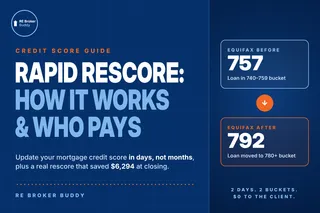
Rapid Rescore: How It Works, How Long It Takes and Who Pays
What a rapid rescore is, how it works, how long it takes, what it costs and who pays, what it can't fix, and a real rescore that saved $6,294 at closing. ...more
DSCR loans
October 28, 2026

FICO vs. VantageScore for Mortgages: Which Credit Score Do Lenders Use?
Which credit score mortgage lenders use, how classic FICO and VantageScore 4.0 differ, why Credit Karma doesn't match your mortgage score, and which loans now accept VantageScore 4.0. ...more
DSCR loans ,Mortgage Market Updates
October 28, 2026
Where We Offer DSCR Loans
*Must Close in LLC
STEP 1
Apply Online or Call Directly
Find out how much home you can buy or discover how much you can save by refinancing.
STEP 2
Review What Options You Can Qualify For
Learn exactly how much you qualify for and what you would save by working with us.
STEP 3
Get Loan Approval in 24 Hours
Get mortgage loan approval to move forward with your property.


Broker Buddy LLC
Trevor Gravink
Mortgage Consultant
CEO/Owner
(619) 404-6637
NMLS: 1707407
NMLS Consumer Access Lookup Tool
CA DRE # 02117228
5371 Wilshire Dr. San Diego, CA 92116
© 2026 Broker Buddy LLC
Powered by Adaptive Mortgage Solutions
Company NMLS # 2022974
CA DRE # 02126109